Showing posts with label Agricultural. Show all posts

Saturday, February 19, 2022

Savandara (සැවැන්දරා)

Savandara (සැවැන්දරා) Tamil: Vettver, Kuruver Vetiveria zizanioides, or Chrysopogon zizanioides
closely related to Sorghum but shares many morphological characteristics with other fragrant grasses, such as lemongrass (Cymbopogon citratus), citronella (Cymbopogon nardus, C. winterianus), and palmarosa (Cymbopogon martinii).

Vetiveria zizanioides0.jpg
bring down body heat and are packed with natural antioxidants that reduce inflammation in the body. As for the roots, the essential oil extracted from them via steam distillation is an important base ingredient in perfumery.

Long before Zara and Dior used vetiver in their luxury perfumes, Indians had been using this aromatic grass in their everyday life.

A part of the contraption was filled with water, drenching the vetiver mats. The hot air from outside would cool as it passed through the wet mats into the cage, and the fan would blow this cool, moist air into the room. Relief was brought by this sweet-smelling air.

This concept was used in Fiji a few decades ago when severe erosion endangered its sugarcane farms. After using vetiver, the land regained its health, erosion all but disappeared, and yields doubled. Today, the farmers of Fiji swear by this grass.

As the Vetiver Network International says, “If applied correctly, the Vetiver System could be an important tool to reduce erosion (by up to 90%), reduce and conserve rainfall-runoff (by as much as 70%), improve groundwater recharge, remove pollutants from water, reduce the risk of flooding, and improve economic benefits to communities.”

Savendara Sugandayen .. by MS Fernando


Excerpts from
https://www.thebetterindia.com/264330/vetiver-wonder-grass-khus-sherbet-indian-summer-sikki-craft-traditional-knowledge/

Also read

https://www.vetiver.org/

https://en.wikipedia.org/wiki/Chrysopogon_zizanioides

Sinhala Wiki
https://si.wikipedia.org/wiki/%E0%B7%83%E0%B7%90%E0%B7%80%E0%B7%90%E0%B6%B1%E0%B7%8A%E0%B6%AF%E0%B6%BB%E0%B7%8F

Thursday, May 27, 2021

කරවලකැබිල්ල. Bignay (Philippines) wild cherry and currant tree (Antidesma bunius)

Planted a few days ago. Sinhala කරවලකැබිල්ල  Karawalakebilla  (Tamil: நாளைதளி Nolaidali ) Bignay (Philippines), Mao Luang,  wild cherry and currant tree (Antidesma bunius). Attracts birds and can become a 15m (45 foot) tree.

The skin of the fruit has red juice, while the white pulp has colorless juice. The fruit contains a light-colored seed. The fruit has a sour taste similar to that of the cranberry when immature, and a tart but sweet taste when ripe. This tree is cultivated across its native range and the fruits are most often used for making wine and tea and is also used to make jams and jellies. 
Rich in antioxidants and anticancer properties. The leaves can be eaten and can be included in a salad mix.

photo

Antidesma bunius
https://en.wikipedia.org/wiki/Antidesma_bunius

Video in Sinhala
https://www.youtube.com/watch?v=lqkgn3iDNwM&t=182s

Wednesday, September 30, 2020

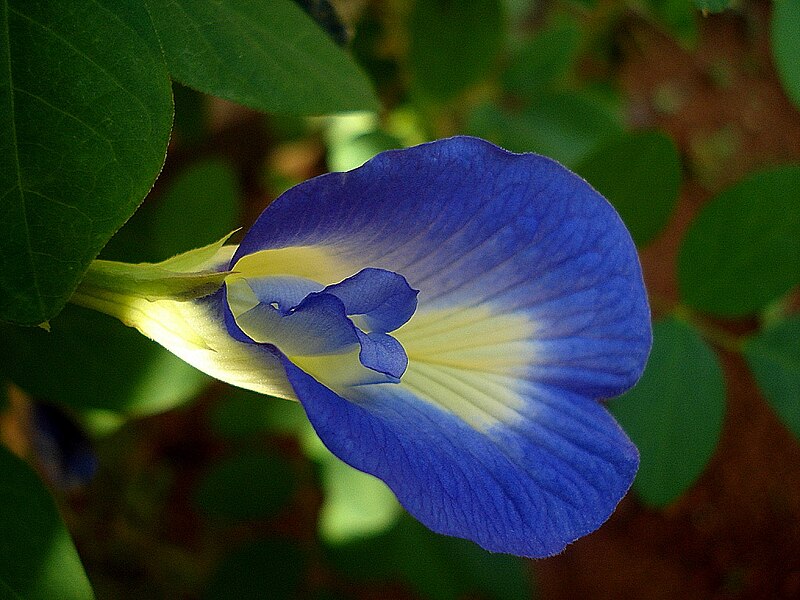
Clitoria, Butterfly Flea, (Sinhala: Katarolu, කටරොළු)

Clitoria ternatea, Butterfly Flea, (Sinhala: Katarolu, කටරොළු) two types blue or white flowers.  The blue flower variety is very common and grows wild and considered a weed in rural areas. 

    https://upload.wikimedia.org/wikipedia/commons/4/4c/Sangupushpam.jpeg.jpg 

Uses:

  • Southeast Asia, the flower is used as a natural food colouring
  • Thai cuisine the flowers are dipped in batter and fried.


Tea from the flower

  • Flower tea and dried lemongrass
  • with lemon juice turns it purple
  • With honey and lemon gives the tea a pink-purple color


With Gin

  •  Blue in the bottle (Needs to be stored in a dark place to keep color)
  •  Pink when mixed with a carbonated mixer


From      
https://en.wikipedia.org/wiki/Clitoria_ternatea

Also see
https://www.researchgate.net/publication/331546748_Evaluation_of_Antioxidant_Properties_of_Different_Types_of_Katarolu_Clitoria_ternatea_L_Flowers_Grown_in_Sri_Lanka

Tuesday, August 18, 2020

Olu (ඕලු), Nelum (නෙලුම්), and Manel (මානෙල්)

There is some confusion regarding Olu (ඕලු), Nelum (නෙලුම්), and Manel (මානෙල්) flowers and its English names.  To be honest I am not  sure I have got it 100% right, so open to correction.

The confusion is because Sinhala and English do not match one to one. 
A very good example is Honey and Pani (පැණි) is considered equivalent.
Pani පැණි is Syrup in Sinhala.  Honey is  Mi Pani මි පැණි (i.e. Bee Syrup),  Coconut Syrup is Pol Pani පොල් පැණි (i.e. coconut syrup) and medicine syrups beheth pani බෙහෙත් පැණි i.e. medicine syrup

Nil Manel (නිල් මානෙල්) (Nymphaea nouchali)

It is a Lily and the National Flower of Sri Lanka.   Though a Lily it is also called blue lotus*, star lotus
The Lilly Of Life.JPG
In Sri Lanka, this plant usually grows in buffalo ponds and natural wetlands. Its beautiful aquatic flower has been mentioned in Sanskrit, Pali, and Sinhala literary works since ancient times under the names kuvalaya, indhīwara, niluppala, nilothpala, and nilupul as a symbol of virtue, discipline, and purity. Buddhist lore in Sri Lanka claims that this flower was one of the 108 auspicious signs found on Prince Siddhartha's footprint. It is said that when Buddha died, lotus flowers blossomed everywhere he had walked in his lifetime.

Claire Waight Keller included the plant to represent Sri Lanka in Meghan Markle's wedding veil, which included the distinctive flora of each Commonwealth country

For you eternal children, a reminder, Tintin and the Blue Lotus.

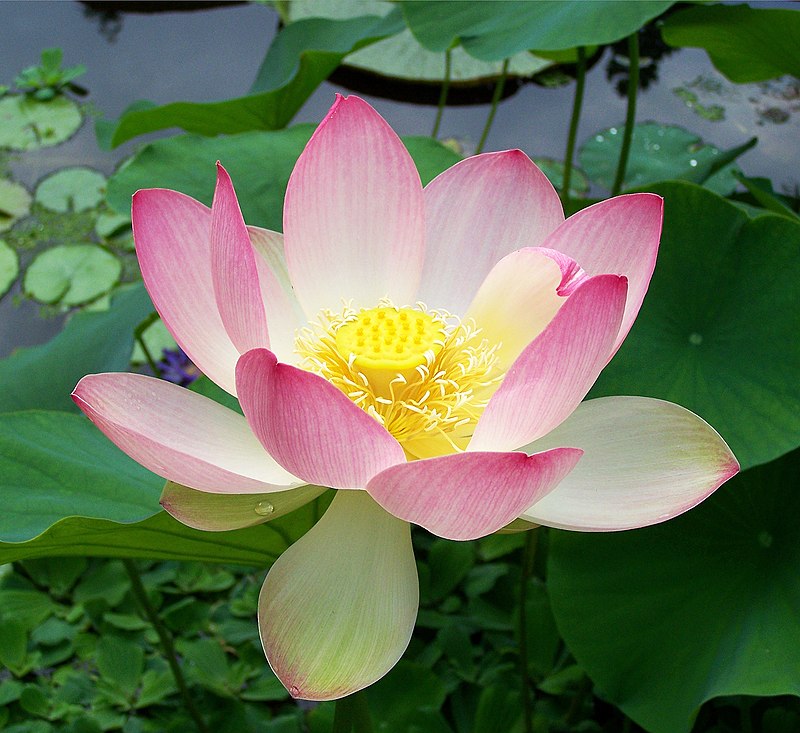
Nelum (නෙලුම්) (Nelumbo nucifera)

Known as just Lotus or Indian lotus or sacred lotus.  Just to confuse the naming, it is also called water Lily and confused with water lilies of genus Nymphae.
Sacred lotus Nelumbo nucifera.jpg
"Nelumbo" is derived from the Sinhalese word Nelum.

The roots of lotus are planted in the soil of the pond or river bottom, while the leaves float on the water's surface or are held well above it. The flowers are usually found on thick stems rising several centimeters above the leaves.

An individual lotus can live for over a thousand years and has the rare ability to revive into activity after stasis. In 1994, a seed from a sacred lotus, dated at roughly 1,300 years old ± 270 years, was successfully germinated.

In Sri Lanka (and other countries) the yams are eaten as curries.


Olu (ඕලු) Nymphaea Lotus

This is a Lily, i.e in the family Nymphae.  Obviously to confuse everyone, it is called White Lotus or Egyptian Lotus.


Lily pads which float on the water, and blossoms which rise above the water. 

In Sri Lanka (and other countries) the yams are eaten as curries. The young fruits are sometimes consumed as a salad (not SL as far as I know). The fresh seeds, white color taste like almonds.  The dried seeds are cooked like a rice.  To cook the seeds, one must either soak it for a day before boiling or cook it in a pressure cooker. Olu haal kandha (Olu rice porridge) is a healthy and wholesome preparation from ground olu seeds and is generally consumed for breakfast.


A short and sweet description of differences

The leaves of lotus are emergent, meaning that they rise above the water level whereas the leaves of water-lily are found floating on the water surface. Same is true for their respective flowers; lotus flowers are emergent and water-lily flowers are floating."
https://laidbackgardener.blog/tag/difference-between-a-lotus-and-a-water-lily/water-lily/

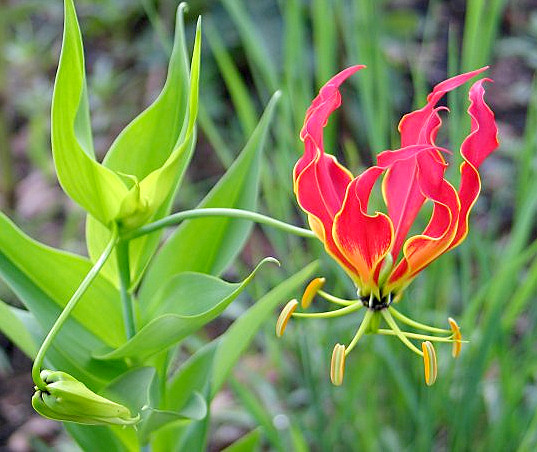
Flame lily, Sinhala Niyangala, (නියඟලා)


Flame Lily.jpg


Flame lily, Sinhala Niyangala, (නියඟලා) Extremely poisonous and beautiful.
Had a term like, Wifes Friend in Sinhala. Cook the yam with potatoes and give the husband to get rid of him. Luckily hard to find, so would have be really long premeditated murder.

From Wiki

It is also the national flower of Tamil Eelam, and as such was displayed during Maaveerar Day and the state flower of Indian state of Tamil Nadu (Tamil: senganthal (செங்காந்தள்) or kanvali kizhangu (கண்வலிக்கிழங்கு)).

This plant is poisonous, toxic enough to cause human and animal fatalities if ingested. It has been used to commit murder, to achieve suicide, and to kill animals. Every part of the plant is poisonous, especially the tuberous rhizomes (yams).

Research* shows that poisoning mimics infection, so poisoning is not suspected.
Research paper cause was found because the patient finally said he had consumed with the intention of committing suicide.

It also takes 10-12 hours for effects to be seem. The longer a poison takes, the better for the poisoner. i.e. A wider range of potential poisoner suspects.


References:
https://www.ncbi.nlm.nih.gov/pmc/articles/PMC4587877/
https://en.wikipedia.org/wiki/Gloriosa_superba

*
Thanks Suchetha Wijeynayake for the tip on the paper.

Thursday, June 18, 2020

Genghis Khan cooled the planet

https://imgs.mongabay.com/wp-content/uploads/sites/20/2011/01/06121126/ghengis-khan.jpgGenghis Khan and his empire, which lasted nearly two centuries, actually cooled the Earth.

told in one word: reforestation. When the Mongol hordes invaded Asia, the Middle East, and Europe they left behind a massive body count, depopulating many regions. With less people, large swathes of cultivated fields eventually returned to forests, absorbing carbon dioxide from the atmosphere.

the conquest of the Americas (killing of 95% of First Nations) there was enough time for the forests to re-grow and absorb significant amounts of carbon.
Recovery of forests following the collapse of human populations in the Americas after the arrival of Europeans may have driven the period of global cooling from 1500-1750 known as the Little Ice Age,

humans started to influence the environment thousands of years ago by changing the vegetation cover of the Earth‘s landscapes when we cleared forests for agriculture.


From
https://news.mongabay.com/2011/01/how-genghis-khan-cooled-the-planet/

Also see
http://wilpattuhouse.blogspot.com/2015/10/american-prairie-and-amazon-forest-man.html

Wednesday, September 21, 2016

GM Mustard in India: Cautionary tale for Sri Lanka

Mustard Plants
There is nasty debate going on about the use of a Indian developed Genetically Modified (GM) mustard plant to be commercially cultivated. Mustard DMH-11, has been developed by Centre for Genetic Manipulation of Crop Plants at Delhi University.  It is a cautionary tale for Sri Lanka.

The Pros
  • Purported to be 20%-30% more productive than most mustard varieties. 
  •  Is resistant to herbicide Basta (Glufosinate) made by Bayer 
Cons
  • Is resistant to herbicide Basta (Glufosinate) made by Bayer
  • Basta chemicals persist in food where herbicide is used 
  • Contains genes barnase, barstar and bar genes patented by Bayer
  • Barnase, barstar and bar are terminator genes and extremely potent cell poison.
  • GM Mustard DMH-11 patent will be held by Deepak Pantel  
The sales pitch for the GM Mustard is that it will solve India's cooking oil problem with higher mustard oil yields. In 2014-15, India imported 14.5 million tonnes of edible oils valued at $10.5 billion, more than half its edible oil requirement.

Rapeseed
Aside: Rapeseed (similar to mustard) grown in Canada is all GM modified.  For you health buffs, thats Canola (contraction of Canada and ola, meaning oil).  So not only is Canola from GM rapeseed it also contains glucosinolates responsible for metabolism disruption and erucic acid, which is damaging to cardiac muscle.   Maybe that why its called Canola and not rape-seed oil.

Back to India: How did India end importing half its edible oil. India was almost self-sufficient in edible oils by the mid-1990s, but by 2014 it was the world’s biggest importer of cooking oils. Under pressure from the World Bank, India began to reduce import tariffs on edible oils and imports then began to increase.

So this push for GM Mustard is little more than a smokescreen to divert attention from this reality, which has to date certainly benefited US agribusiness Cargill. What is more deceptive is that the genetically engineered mustard does not produce higher yields than non-GM mustard.

Patent Royalties,  sales of weedicide by Bayer to a 10.5 billion market is also the push for GM Mustard.  Deepak Pantel is not an independent scientist pushing GM Mustard but one salivating to collect patent royalties.

On a final note, Bayer and Monsanto have merged, DuPont and Dow are planning a merger and ChemChina is buying Syngenta.

References
http://navdanya.org/news/604-violation-of-indias-ipr-laws-and-competition-act-by-mncs 
http://www.counterpunch.org/2016/09/21/is-india-about-to-make-a-catastrophic-mistake-with-gm-mustard/

Thursday, June 2, 2016

Glyphosate Found in Urine of 93 percent of Americans Tested


Glyphosate, labeled a “probable human carcinogen” by the World Health Organization’s cancer agency IARC in 2015, has now been revealed to be ubiquitous in the first ever comprehensive and validated LC/MS/MS testing project to be carried out across America.

In a unique public testing project carried out by a laboratory at the University of California San Francisco (UCSF), glyphosate was discovered in 93 percent of urine samples during the early phase of the testing in 2015.

The unique project, which has already provided more urine samples for testing than any other glyphosate bio-monitoring urine study ever in America, was supported by members of the public, who themselves paid for their urine and water samples to be analyzed for glyphosate residues by the UCSF lab.

Glyphosate was found in 93 percent of the 131 urine samples tested at an average level of 3.096 parts per billion (PPB). Children had the highest levels with an average of 3.586 PPB.
The regions with the highest levels were the West and the Midwest with an average of 3.053 PPB and 3.050 PPB respectively.

(n.b. US West and mid west has the most agriculture)

Glyphosate residues were not observed in any tap water samples during the early phase of the project, most likely due to phosphorus removal during water treatment.
The results from the UCSF urine testing in America showed a much higher frequency and average glyphosate level than those observed in urine samples in the European Union in 2013. The average level in Europe was around 1 PPB with a frequency of detection of 43.9 percent.

Glyphosate has never been studied by regulators or the chemical industry at levels that the human population in the U.S. is being exposed to (under 3 mg/kg body weight/day). This is a huge hole in the risk assessment process for glyphosate, as evidence suggests that low levels of the chemical may hack hormones even more than high levels—a higher dose does not necessarily mean a more toxic, hormone disruptive effect.

From Comments
Glyphosate (Roundup) was initially patented as a pipe descaler -- it binds with minerals, making them easier to remove. It binds with minerals in GMO crops (which are genetically modified to withstand it's lethal effects) as well as in humans, blocking absorption/utilization.


https://ecowatch.com/2016/05/29/urine-test-monsanto-glyphosate/

Saturday, May 21, 2016

Is the Dry Zone becoming a Wet Zone

 Many Sri Lankans may remember from school geography the Dry Zone of Sri Lanka is from North West (Puttalam) to East (Batticoloa) and South East (Hambanthota).  In this area rain is received only from the North East (NE) monsoon, i.e. mid-late October to January.  May to November is dry with hardly any rain.

Has this changed. Last year (2015) there was moderate rain even in June, in the North West (Puttalam).  This year (2016) it has been heavy rains and floods in mid May and more expected at the end of May as well. So will the Dry Zone, at very least NW have rains in the coming years during the historical dry season. At very least during El Nino year, it is still El Nino conditions this year.
I think so, Sri Lanka is going to have rain and lots of it.  Why, because
  • The Indian ocean is warming up
  • Air temperature is warming
  • Water Vapor in Atmosphere
  • Amount of Water Carrying capacity increases exponentially.
The critical physics is Water carrying capacity (saturation)  of the Atmosphere.  That is the amount of water vapor that the atmosphere can hold at any given temperature.  This amount of water vapor that atmosphere can hold increases very quickly after about 30°C.

So with the air temperature increasing, the Indian ocean warming up,  there is going to be a lot more water vapor in the atmosphere. Specially above Sri Lanka because we are an Island.  So all that increased water vapor in the atmosphere comes down in a deluge, i.e. buckets of water not raindrops.

Is it possible during the SW monsoon, there is so much water in the atmosphere now, part of it get carried over into the Dry Zone.  Just like the more intense NE monsoon rainfall getting carried over to the wet zone.

Anecdote
This property (Wilpattu House) was bought in Sep 2011.  I was told the last time that the Lunu Ela (river bordering the property) was 20 years ago.  However, there has been a flood of the Lunu Ela every year in December, except 2013.  This year, even in May.  Old timers say never during their lifetime floods, let alone heavy rains in May.

One may well argue whether Climate Change is man made or natural occurrence.  If one thinks it is because of humans, the results of whatever mitigation (e.g. less Fossil Fuel, re forestation)  will be seen many many year later.   At the moment Climate Change is here to stay for the next few decades.

What is needed is how do we work around the effects of climate change.  For instance, flooding in Colombo will be the norm.  What kind of infra structure is needed (e.g. canals) to reduce or eliminate flooding in Colombo.  Warning systems for Landslides.  What kind of crops can handle flooding and heavy rains. Thats whats needed at the moment, not discussions of reducing fossil fuels and changing to solar power (all very good).


A comment I made in 2010

If you think in general that air temperatures have increased, you will see larger increases in rain (precipitation).
The reason is that the water holding capacity of air increases exponentially with increasing temperature. i.e. Small increases in air temperature at around 38-40C will have much larger increases in water holding capacity. See link below.
Water Vapor .
Bottom Line: Expect Deluges to be the norm even in the North East.

Friday, March 18, 2016

Flawed Analysis: Prof. Dharmawardana on CKDu and Glyposate

Prof. Dharmawardana has an article that dismisses links between CKDu, glyphosate and chemical fertilizers.  However this analysis is severely flawed.

To quote Prof. Dharmawardana:

New Zealand is one of the biggest users of synthetic fertilizer, applying 1700 kg/hectare in 2012. Other comparative figures (per hectare, World Bank data) are, Malaysia,1600, Singapore 3400, Holland 300, India 165, Sri Lanka 198, Nicaragua 50. Both Nicaragua and Sri Lanka have chronic kidney disease of unknown origin (CKDu). There are similar trends for glyphosate (herbicide) use. While Nicaragua uses very little fertilizer and glyphosate, New Zealand which uses more than 34 times has no CKDu.
The proposed link (e.g. Jayasumana et al (2014) ) is between hard (Ca++ and Mg++) ground water used for drinking and glyphosate and chemical fertilizer use in surrounding areas.

The flawed analysis of Prof. Dharmawardana ignores
a) New Zealand has high rainfall and rural communities use rain water collected from roofs for drinking purposes.
b) Sri Lanka does not have a CKDu problem is the wet zone.
c) Jaffna which has hard ground water has low incidence of CKDu because agro chemicals were prohibited during the war.

Related Links
Chronic Kidney Disease: Cause Hard Water + Heavy Metals + RoundUp
Groundwater Depletion, Chronic Kidney Disease (CKDu) and Jaffna .


Friday, October 16, 2015

American Prairie and Amazon Forest: Man Made ?

A very interesting theory from an article in 2002.  American Prairie and Amazon forest have been shaped by humans over thousands of years, and are not pristine environments as previously thought.  The Native Americans burned the Prairie Grasses to create a habitat ideal for bison, elk and deer; i.e. a gigantic farm for meat.  In the Amazon Forest, Amazonians created large tracts of very fertile super soil (Terra Preta wiki) in an infertile area.

The initial evidence for Prairie burning was as follows.
  • de Soto's travels thru South East US in 1539 did not see bison.
  • Archaeology of settlements shows very little bison/elk bones 
  • Disease brought in by Soto and crowd (and pigs) kills off the Native Americans.
  • 100 years later French explorers in the South East US saw no traces of man instead huge herds of bison
  • Conclusion: Native Americans kept bison population down. After Native Americans died of European diseases the bison numbers exploded.
Anyway excerpts article.
Every tomato in Italy, every potato in Ireland, and every hot pepper in Thailand came from this hemisphere. Worldwide, more than half the crops grown today were initially developed in the Americas.

The Aztec capital of Tenochtitlán dazzled Hernán Cortés in 1519; it was bigger than Paris, Europe's greatest metropolis. The Spaniards gawped like hayseeds at the wide streets, ornately carved buildings, and markets bright with goods from hundreds of miles away. They had never before seen a city with botanical gardens, for the excellent reason that none existed in Europe. The same novelty attended the force of a thousand men that kept the crowded streets immaculate. (Streets that weren't ankle-deep in sewage! The conquistadors had never heard of such a thing.)

The Hurons, a chagrined missionary reported, thought the French possessed "little intelligence in comparison to themselves." Europeans, Indians said, were physically weak, sexually untrustworthy, atrociously ugly, and just plain dirty. (Spaniards, who seldom if ever bathed, were amazed by the Aztec desire for personal cleanliness.)
Rather than domesticating animals for meat, Indians retooled whole ecosystems to grow bumper crops of elk, deer, and bison. The first white settlers in Ohio found forests as open as English parks—they could drive carriages through the woods.

In North America, Indian torches had their biggest impact on the Midwestern prairie, much or most of which was created and maintained by fire. Millennia of exuberant burning shaped the plains into vast buffalo farms. When Indian societies disintegrated, forest invaded savannah in Wisconsin, Illinois, Kansas, Nebraska, and the Texas Hill Country.

Yet recently a growing number of researchers have come to believe that Indian societies had an enormous environmental impact on the jungle. Indeed, some anthropologists have called the Amazon forest itself a cultural artifact—that is, an artificial object.

In a widely cited article from 1989, William Balée, the Tulane anthropologist, cautiously estimated that about 12 percent of the nonflooded Amazon forest was of anthropogenic origin—directly or indirectly created by human beings. In some circles this is now seen as a conservative position. "I basically think it's all human-created," Clement told me in Brazil. He argues that Indians changed the assortment and density of species throughout the region.
Update

Strange Forest Patches Littering The Amazon Point to Agriculture 10,000 Years Ago
Now, thanks to new analysis of the sediment found in some of these islands, researchers have unearthed signs that these spots were used to grow cassava (manioc) and squash a little over 10,000 years ago.
That's impressive, as this timing places them some 8,000 years earlier than scientists had previously found evidence for, indicating that the people who lived in this part of the world - the southwestern corner of the Amazon basin - got a head start on farming practices.


https://www.sciencealert.com/the-amazon-basin-was-an-ancient-agricultural-hotspot-10-000-year-old-evidence-says

References

http://www.theatlantic.com/magazine/archive/2002/03/1491/302445/
http://www.instructables.com/id/Make-your-own-BioChar-and-Terra-Preta/?ALLSTEPS
http://news.nationalgeographic.com/news/2008/11/081119-lost-cities-amazon.html 
http://www.fws.gov/refuge/Neal_Smith/wildlife_and_habitat/tallgrass_prairie.html
http://news.nationalgeographic.com/news/2008/11/081119-lost-cities-amazon.html

This is the Knox of N. America.  La relación of Álvar Núñez Cabeza de Vaca (1528-15386)
https://ia800504.us.archive.org/15/items/journeyofalvarnu00n/journeyofalvarnu00n.pdf

Thursday, June 11, 2015

Mexican SunFlower(වල් සුරියකාන්ත): Great Fertilizer

Found out a couple of months ago from a visitor here that Mexican Sunflower (වල් සුරියකාන්ත) Tithonia Diversifoliais a very good fertilizer. Thanks Anil Ratnayake.

Mexican Sunflower is fast growing, not fast enough here because we would like to use it extensively as soil conditioner and fertilizer. It is a weed and invasive species that originated from Central America.
  • High in Pottasium (low in Mg).  As fertilizer contains 1.76% N, 0.82% P, and 3.92% K.
    In comparison cattle manure 0.6% N 0.4% P 0.5% K
    Giliricidia 3.26% N 0.41% P 2.76% K
  • Soil conditioner, i.e. loosens soil.
    Much needed here because of clayey soil that becomes like rock when dry and prevents root growth.
  • Decomposes fast, so nutrients available quickly.
    That means can be used for short duration crops such as vegetables.
  • Grows from plant cuttings. i.e. easily propagated.
    The plant cuttings seem to be tolerant of hard water (High Mg, Ca).
  • Attracts Butterflies and Bees (a big plus).
  • Beautiful Flowers
 Anecdote:  My sister has a Rambutan plant that has barely grown in two years. Probably because the garden has been filled with gravel/gritty soil (බොරලු). About two-three months ago she had planted a Mexican sunflower next to a Rambutan plant.  This was before we knew about the soil conditioning properties. Anyway within the last two months the Rambutan plat has grown by about 2 feet.

References and Links 

Study  of Mexican Sunflower on Rice
http://www.agrilearning.goviya.lk/Paddy/Paddy_Research/Paddy_pdf/A27.pdf

NPK values of Manures
http://www.allotment-garden.org/compost-fertiliser/npk-manures-compost.php


sbarrkum

Thursday, May 21, 2015

Cashew Apple Wine

Cashew Apples, the fruit of the cashew is hardly used in Sri Lanka. A few of them will be eaten with salt and pepper.

There is a lot of information on how to make cashew apple wine.  I think this is a really great idea, especially if it is a local (small towns and villages) small scale operation.  It would provide employment/small business and a truly value added product from a produce that goes to waste.   The downside is that the facility will only be operation for a short period of time. Thats because Cashew is a seasonal bearing fruit (around april/may).  The solution to seasonality would be to use the wine producing facility to use other fruits and produce wine.  April to October is fruit bearing season in the dry zone, with plenty of fruits going to waste. e.g. Dham which is eaten and at time made into a local syrup much like blueberry syrup.

India is also looking into making Cashew Apple Wine
China too has a growing fruit wine industry

Below is recipe to make Cashew Apple wine at home from DrinksPlanet
  • Top and tail a kilo of ripe cashew apples, 
  • Roughly chop them (quartering them will do) and put them into a large pot.
    Optionally can keep in salt water for 3 days to remove tannin.
  • Add 100 grams sugar and leave to soak for 15 mins or so.
  • Then strain off the juice.
    Optionally Can add 100mg/L sodium metabisulfite to inhibit the growth ofacetic acid bacteria, wild yeasts and molds.
  • Put the juice into a 2 liter glass bottle (maybe even earthen ware pot)
    (it should be about 3/4 full)
  • Add a small packet of wine yeast (1/2 a teaspoon?) and shake well.
  • Fit an Fermentation Lock.
    Here is how to make Fermentation Lock at home
  • Leave it in a dark place for a week or two until it stops bubbling, 
  • Then carefully rack it off into another clean jar (leaving all the muck behind).
  • Refit the airlock and leave it to clear.
  • You could help the clearing along by adding some Bentonite (optional).
    Bentonite is Aluminium phyllosilicate, impure clay consisting mostly of montmorillonite.
    Might be better to use powdered sago ()
    You need 2 grams powdered sago boiled in 10 ml water.
    Add it to the wine and stir like crazy. Then leave it overnight to clear.
  • Decant it off into bottles.
Store it until you are ready to drink it.


A more industrial recipie
http://foodrecap.net/manufacture/wine/make-cashew-wine/

Research Paper
http://www.researchgate.net/publication/227760139_Fermentation_of_cashew_%28Anacardium_occidentale_L.%29_apple_into_wine